
How to Find Who Owns a Galax Property
Finding a Galax owner takes three records in order. Start with the street address. That locates the parcel in the WebGIS map. The Commissioner of the Revenue card then names the administrative owner under the local assessment, and the Circuit Court Clerk's newest recorded conveyance confirms what actually transferred. The city's assessment FAQ says a parcel record lists who owns the property, though the exact live field label can differ between systems, so search Galax property records with a short address first and carry the map number or legal description into each next step.
- Locate the likely parcel in Galax WebGIS and copy its tax/map key as shown.
- Read the Commissioner of Revenue record for the owner field, situs, acreage, class, and value context.
- Search SRA/COVERS for the newest deed involving that grantee and read the instrument and legal description.
- If a company, estate, trust, or fiduciary appears, search that name style and the related filing.
- Keep assessment, deed, and map dates separate when you describe the current owner.
Sources That Identify Who Owns a Galax Property
No single Galax source answers every ownership question. The tax roll helps surface a name. The land index records conveyances, the parcel map joins a shape to a tax reference, and the State Corporation Commission explains a company that holds title. Compare these records with each other rather than treating a web result as a final ownership finding.
| Source | Owner information | Access and limit |
|---|---|---|
| Commissioner of Revenue | Parcel record card says who owns it, with situs and assessment fields | WebGIS/office; exact live labels unverified |
| Circuit Court deed index | Recorded grantor, grantee, document, and date | SRA/COVERS; Galax cutoff and image terms need clerk confirmation |
| Galax WebGIS | Parcel location and map result; card details depend on enabled fields | Public map; not a title search or survey |
| Virginia SCC CIS | Entity name, type, status, address, and agent details | Business record; not proof of parcel ownership |
An owner of record is one name in one record at one date. It is not proof of occupancy. The person living in the house may not be the grantee, and an agent or permit applicant often is not either.
The Galax WebGIS parcel map displays search and identify tools for locating a tax parcel. It shows the map interface. It is not a person's parcel card.
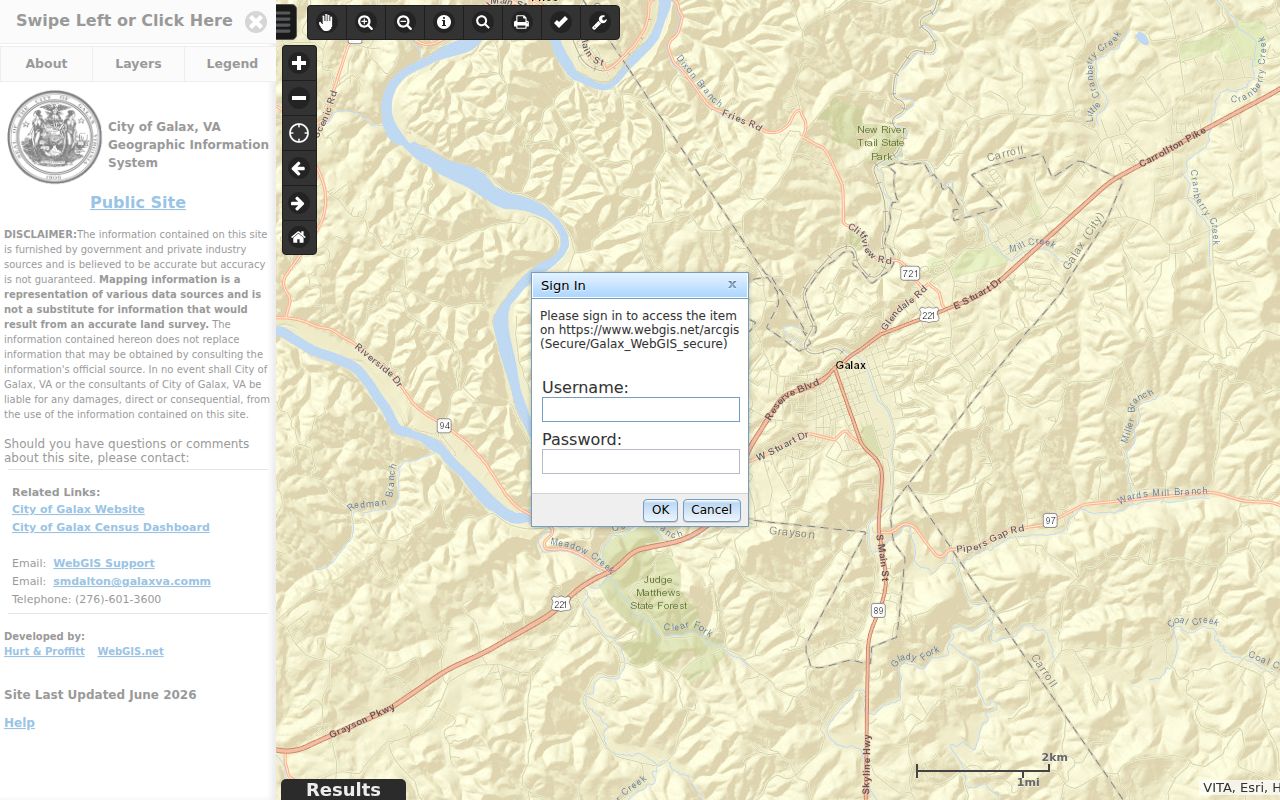
Use the live map result to identify the parcel. Then verify the owner name in the assessment record and the recorded deed.
Reading the Galax Owner Field Carefully
The 2024 reassessment FAQ describes what a Galax parcel file holds: who owns the property, the location address, acreage, property class, land and structure values, depreciation, and market adjustments. The FAQ does not name the exact WebGIS field label or promise a mailing address, deed reference, or last-sale field. Inspect the live card when the exact field matters. The Commissioner of the Revenue can supply a copy.
The tax roll is an administrative snapshot, not a live title chain. Galax reassesses on a four-year cycle. A deed recorded last month may not appear on the current tax card yet. When names differ, compare the recording date, the assessment effective date, the parcel key, the legal description, and any pending estate or fiduciary filing. The longer name is not automatically the newest titleholder. Only the recorded instrument settles that.
Who Owns a Galax Property: Confirming the Recorded Deed
The Circuit Court Clerk keeps Galax land records. Virginia's SRA/COVERS system is the online index for recorded instruments. The clerk can say whether it reaches back to the cutoff you need. Match the newest recorded conveyance to the same legal description as the tax parcel. A party name alone can mislead. It may point to another property or an older transaction entirely.
Once you find the deed, note the grantor, the grantee, the recording date. Also note the instrument number or book and page. Note any referenced documents too. Images may sit behind a subscriber limit. The clerk can explain access or provide a copy. The question may be whether a transfer was recorded. Compare this deed's grantor with the prior deed's grantee. That comparison is the confirmation step. It is not a full title search.
Older Galax ownership chains can cross a local-government line. Galax became an independent city in 1953. Charter §21.10 keeps instruments recorded in the county before the transition at the recording location. That is the location the law required at the time. A current Galax assessment card will not point to every historical volume in that earlier chain. Match the legal description. Follow each deed's prior-instrument references. Ask the clerk which office holds a pre-transition book when the online index stops short.
When a Galax Property Owner Is an LLC
A Galax deed or assessment card may name an LLC. Take the exact wording to the Virginia SCC Clerk's Information System. The entity search accepts a name or an ID. Enter the name exactly as written. Try a shortened form only to spot variants. Expect results like entity type, status, formation date, address, and name type, sometimes with registered-agent and filing detail.
Treat the entity details with care. An agent's address is not the parcel's mailing address. A company officer or registered agent may sign for the entity without holding personal title. The recorded deed and its legal description remain the evidence. They connect that grantee to the land.
The Virginia SCC entity search is the official starting point. It is not a parcel result. Return to the recorded Galax deed and its legal description. Verify the actual property transfer there.
Check the company's identity in the entity result. Then return to the recorded circuit deed to verify the property transfer.
Who Owns a Galax Property Held by a Trust or Estate
Trust deeds rarely name a living person. Instead, the grantee line may read as a trust, a trustee, or a successor trustee. Estate transfers vary just as much. A decedent's name may appear, or an executor, administrator, fiduciary deed, deed of distribution, or court order. Run each documented name through the Galax land index. Then confirm the matching probate or deed record. Names alone do not settle title. A probate pleading name is not a title holder. When the assessor still lists a decedent, the tax roll likely has not caught up with a recorded fiduciary transfer, and the deed, court order, or deed of distribution is the instrument to weigh against the land description. Virginia keeps death records restricted, so a probate file or newspaper notice may be the better lead while a certificate stays closed.
Galax Mailing Address Is Not Occupancy Proof
A situs marks where the parcel sits. A mailing address is something else entirely. It routes tax notices, and it might be an owner's home, a PO box, or a management address. So check the Galax parcel card. Do not assume it shows a mailing field. Even a verified tax mailing address does not prove who lives at the property. Galax is an independent city. It sits beside Carroll and Grayson Counties, and postal geography can cross the city line. Match the parcel on the map and confirm the assessment jurisdiction before treating a mailing line as evidence about the place. Virginia's Address Confidentiality Program lets protected participants use substitute addresses. Treat an unfamiliar address as a reason to ask the custodian, not to infer a location.
Galax Owner-of-Record Terms and Privacy Limits
Owner of record means the name a specified record source shows. Grantee is whoever receives the conveyance. Title is the legal interest those instruments prove. Situs is the physical location. A mailing address, by contrast, exists for correspondence. These distinctions explain why a tax card, a deed, and an occupant never answer the same question. Virginia law closes off some sensitive records, including vital records before their public opening periods and voter information in the state election system. Use a public property record for a real property question, never to identify or pressure a resident.
What a Galax Owner Lookup Cannot Prove
A Galax owner lookup has firm limits. It can identify names in a tax or deed record and join them to a parcel. Occupancy is beyond it. So is a surveyed boundary. No search can guarantee a complete title chain or the absence of an unrecorded claim, and the owner of record may be an entity or a representative acting in a legal role.
Lawful use. Use Galax owner information for property diligence, a transaction, or local history. Do not use records to threaten, stalk, or harass anyone; use a professional title review where legal ownership must be established.